
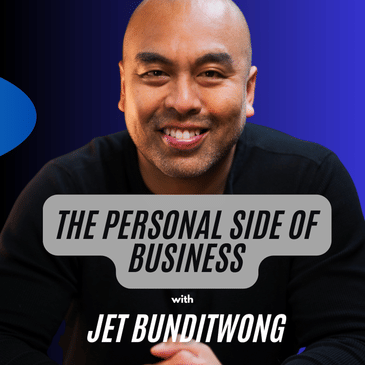
Business coach and author Gary Mitchell joins Jet Bunditwong to explain the AND Approach: building a successful company while protecting family, freedom, health, and personal priorities. Gary discusses delegation, consistent habits, removing owner bottlenecks, developing leaders, and creating a workplace where both the business and its people can thrive.
Learn more about Gary:
https://ontrackcoach.com/
00:00 --> 00:04 Welcome to The Personal Side of Business, where you hear real stories
00:05 --> 00:06 from real entrepreneurs.
00:16 --> 00:20 A special thank you to our sponsor, ErgoNext Insurance, for supporting
00:21 --> 00:24 The Personal Side of Business. If you're an attorney, a paralegal, or a law firm,
00:25 --> 00:28 you work hard to protect your clients, so you should protect your business too.
00:29 --> 00:32 Whether it's professional liability, cyber threats, or everyday business risk,
00:33 --> 00:37 having the proper insurance lets you focus on what matters most— serving your
00:37 --> 00:40 clients with confidence. More than 750 small businesses
00:41 --> 00:45 trust ErgoNext Insurance for their business, and they have a 4.7
00:45 --> 00:48 out of 5-star rating on Google. Getting a customized quote takes about 10
00:48 --> 00:52 minutes. It's all online, and you can tailor coverage to fit your firm's
00:52 --> 00:56 needs. Click the link in the description to get your free quote today and see
00:56 --> 00:59 why so many professionals choose Next Insurance.
00:59 --> 01:02 Hi, and welcome to The Personal Side of Business, where every business has a story.
01:03 --> 01:06 I'm your host, Jeff Bundewald. Today, my guest is Gary Mitchell. For more than
01:06 --> 01:10 2 decades, he's been helping law firm owners build their businesses to create
01:10 --> 01:13 both success and freedom. His new book, The And Approach,
01:13 --> 01:16 argues that you don't have to choose between a thriving business and a fulfilling
01:16 --> 01:20 life. You can have both. Welcome to the podcast, Gary. My pleasure, Jeff. Happy to
01:21 --> 01:23 be here with you. Yeah. So let's start with your story. How did we get
01:24 --> 01:26 here? Okay. I'll give you the Coles Notes cuz I don't wanna take up the
01:27 --> 01:30 whole podcast time. Basically, I've always been a serial entrepreneur. I really
01:30 --> 01:34 have. Usually that's what happens with entrepreneurs. You have a
01:34 --> 01:36 certain bent, a certain, you want to create things, you want to build something.
01:37 --> 01:40 So I started my first business at 25 in Toronto.
01:40 --> 01:44 I built a national event, very successful national marketing partners
01:44 --> 01:46 with big companies, national media exposure.
01:47 --> 01:51 Had no previous experience, just got in there, got my hands dirty, tried things.
01:51 --> 01:55 Some things failed, learned like most entrepreneurs, right? Then I
01:55 --> 01:59 moved out. I By way of that business, I came out to Vancouver to promote
01:59 --> 02:02 the local, the regional event and fell in love with the place.
02:02 --> 02:06 I was like, what am I doing living in Toronto? I soon thereafter got
02:06 --> 02:10 back into politics, ran for Parliament 2004.
02:10 --> 02:14 That's the equivalent of the House of Representatives in the U.S. And thankfully I
02:14 --> 02:18 lost. And I mean that most sincerely. So as fortune would
02:18 --> 02:22 have it, I got approached by a lawyer to run his nomination campaign.
02:22 --> 02:25 That's like your primaries. So he would earn the right to become the candidate.
02:26 --> 02:29 I jumped at the opportunity with the political background that I had. This guy was
02:30 --> 02:34 a good candidate. Uh, well, good person. He knew nothing. He was a blank slate.
02:34 --> 02:37 So imagine an artist with a blank canvas, right? And all
02:37 --> 02:40 my experience, both in front, in front and in behind the
02:40 --> 02:44 scenes as volunteer and, uh, campaigner. So then he won the
02:44 --> 02:48 nomination and was adamant about me becoming his campaign manager. I reluctantly
02:48 --> 02:51 took on that role, but I did. And I was coaching him as a candidate.
02:52 --> 02:55 And it was, it was one of those life aha moments, Jeff. I had always
02:55 --> 02:59 been the guy and now I'm the guy behind the guy. And I really liked
02:59 --> 03:02 it. I really, really liked it. I don't mean from a power point
03:02 --> 03:06 of view or pulling the strings. I mean, from witnessing another
03:06 --> 03:09 human being go through transformation due in part to what I
03:10 --> 03:13 gave him. Right. I mean, he was a, in fairness, he was a
03:13 --> 03:16 complete sponge. He took it. Lawyers are smart when they're given the
03:17 --> 03:20 right direction. I mean, they learn quickly. He became an amazing candidate
03:21 --> 03:24 and was up against 2 veteran politicians. And in the last
03:24 --> 03:27 debate before the election, it was televised. He actually beat them. And I
03:28 --> 03:31 was sitting there in the studio. Right in the back, back end, I'm watching
03:31 --> 03:35 him on TV going, wow. So during this whole experience, his best friend,
03:35 --> 03:38 also a lawyer, took me aside one day and said, Gary, you really need to
03:39 --> 03:42 look at the legal industry. They really need help with these similar
03:42 --> 03:47 types of soft skills, people skills, which are transferable to business,
03:47 --> 03:51 right? Building relationships, networking, speaking, you know,
03:51 --> 03:55 the stuff that lawyers and most professionals are never trained in, right? It's not just
03:55 --> 03:58 lawyers, but My connections were to law.
03:59 --> 04:02 I knew a lot of lawyers from my political background. I then spent 9
04:02 --> 04:06 months researching online what was going on in the US, UK, and Australia,
04:07 --> 04:10 more locally what was going on in Canada. As serendipity would have it,
04:10 --> 04:14 the first chapter of the Legal Marketing Association, which had been around for,
04:14 --> 04:18 I think, 20 years at that point, the first chapter outside of the United
04:18 --> 04:21 States was being formed in Vancouver. I went to the forming meeting. I networked.
04:21 --> 04:25 I met numerous veteran legal marketers from the firms in the
04:26 --> 04:28 US, some of whom I'm still in touch with today, they're friends and colleagues,
04:29 --> 04:32 and just, you know, soaked in, just got as much information and
04:33 --> 04:36 understanding of the industry, lawyers, their needs, the challenges. And not soon after
04:37 --> 04:40 that, I landed my first client. 20 years in, I have niched over
04:40 --> 04:44 the last few years to drill down and work specifically with
04:44 --> 04:48 small law firm owners. And I'm loving it, Jet, because it's entrepreneur
04:48 --> 04:52 to entrepreneur. It reminds me back of the day when I was working directly with
04:52 --> 04:55 the candidate. It was just me and him, and we got so much done in
04:55 --> 04:59 such a short period of time. I mean, I do have this drive and
04:59 --> 05:03 now with the latest book, The AND Approach, this has become my mission.
05:04 --> 05:07 It's become my mission to show law firm owners and soon branching
05:07 --> 05:11 out to all other business owners that you can build a thriving business
05:11 --> 05:15 and have an amazing life with time to enjoy
05:15 --> 05:18 the fruits of all your labor. You put so much time and effort into growing
05:18 --> 05:22 your baby, your business. It's a shame when you see people just chained
05:22 --> 05:25 to the desk, right? Nothing, nothing moves unless
05:25 --> 05:28 they're involved. So this is now my mission and I'm very driven
05:29 --> 05:32 in spreading the word and showing as many business owners because I,
05:33 --> 05:36 you know, small business is at the heart of both economies in the United States
05:36 --> 05:40 and Canada. It accounts for, I can't remember the exact percentage, but it's
05:40 --> 05:43 up there around 80% of GDP. I think it's like 80-something.
05:44 --> 05:48 Yeah. Small business owners. I mean, we drive the economies
05:48 --> 05:51 of our countries and we're innovating. We're creating new things.
05:51 --> 05:54 I would like to see more people enjoy their lives around all
05:54 --> 05:58 the work they've put into that. You know? Yeah. I think, you know, from,
05:58 --> 06:02 from your book, there's a lot of things that, that I felt are really important
06:02 --> 06:06 to be able to spread out, not just in law firms and lawyers,
06:06 --> 06:09 but to be able to do a lot of different businesses. And one
06:09 --> 06:13 of them is building systems. Right? That, that you talk
06:13 --> 06:16 about. And I think that's one of the hardest things for small business owners to
06:16 --> 06:19 do in any industry. It's because you're starting this business,
06:20 --> 06:23 you're getting going, and you're just seeing, you're just seeing this tunnel that
06:23 --> 06:26 you have to try to get to the other side. And for a lot of
06:26 --> 06:29 times that tunnel goes on forever and you're just trying to do it. So for
06:29 --> 06:32 someone to come in there and go, hey, you need to step back for a
06:32 --> 06:35 second and start to build a system so you're not working until you're 85 years
06:36 --> 06:39 old. Maybe you can sell the business. Maybe hire people, start to have
06:39 --> 06:42 a vacation, start to have a life out of it. What are some of the
06:42 --> 06:46 things that you feel are important in a small business owner
06:47 --> 06:50 creating so they can build that life? Okay. This is such a good question and
06:50 --> 06:53 there's so much to unpack in it. First of all, you mentioned selling the
06:53 --> 06:57 business. So one of the first things I do when I work with a firm
06:57 --> 07:01 owner, and typically my clients are at a stage where they have already achieved success,
07:01 --> 07:05 they're usually doing over $2 million a year in revenue already. So they have,
07:05 --> 07:08 they have people working for them. They've hit some bumps.
07:09 --> 07:11 They've got some scars and bruises along the way,
07:12 --> 07:15 right? They've made some mistakes. They've had some success. They've reached a
07:15 --> 07:19 plateau. So the first thing I ask them is, what's your endgame? Where do you
07:19 --> 07:22 see this going? Because here's another example of the and approach.
07:23 --> 07:26 I want to start there and then back it, you know, reverse engineer
07:26 --> 07:30 it, back it to today. And what will happen is over the
07:31 --> 07:33 course of my working with them, we are not only going to have them gain
07:34 --> 07:37 more freedom and I will go into my formula. In just a minute, but I
07:37 --> 07:41 want to give the visual or the vision of this. Not only will they begin
07:41 --> 07:44 to gain more freedom, but they're going to increase the value of their firm
07:44 --> 07:49 or their company. So when it does come time for semi-retirement,
07:49 --> 07:53 full retirement, whatever their next stage of their career is,
07:53 --> 07:56 they have built something that is actually worth something, right?
07:57 --> 08:01 And that's because of the systems, the proven methodology,
08:01 --> 08:04 the team, the talent, You know, someone's coming in,
08:04 --> 08:07 they're buying a turnkey operation. They're not having to reinvent the
08:07 --> 08:11 wheel, including the branding. You know, I'll get them off their lawyer name and
08:11 --> 08:14 get a real, like more corporate kind of, I mean, I love branding.
08:14 --> 08:18 It's creative. I love everything creative. So where do we begin? We begin with a
08:18 --> 08:21 SWOT analysis of the owner, strengths, weaknesses, opportunities,
08:22 --> 08:25 and threats. Now the old school, Jet, I'm a little bit older than you.
08:25 --> 08:29 So in the early days of my entrepreneurial journey,
08:29 --> 08:32 all the books were talking about, you know, you look at your weaknesses. Fill up
08:32 --> 08:36 your socks, you know, fix this, fix that, get better at this,
08:36 --> 08:40 all that. You know, for most of us, it seemed logical. Yeah, we should
08:40 --> 08:44 probably improve our weaknesses. Well, then my number one guru for business
08:44 --> 08:48 leadership, organizational structure, Steve Jobs comes
08:48 --> 08:52 around and he turns that theory upside down in a big way.
08:52 --> 08:56 He said, no, no, no, no, no, no. Don't, don't even worry about your weaknesses.
08:57 --> 09:00 Forget them. Turn all of your attention, focus, and energy to mastering
09:01 --> 09:04 your strengths. So I say to my clients, let's get you to become a
09:04 --> 09:08 Jedi, right? At what your strengths are. And that's not the same for
09:08 --> 09:11 every owner. We could talk about that in a— but that's the first step.
09:11 --> 09:15 From there, then we systematically build the A-team around them.
09:15 --> 09:19 So systematically building complementary skill sets and experiences
09:20 --> 09:23 around their strengths. In the meantime, we're filling the holes left
09:23 --> 09:26 by their weaknesses. And at the end of the day, this allows the owner
09:27 --> 09:30 to start delegating some of the responsibilities off
09:30 --> 09:33 his or her plate, off their desk, slowly but surely.
09:34 --> 09:37 Trust is a big issue with lawyers. Okay. I'm sure it is with other business
09:37 --> 09:41 owners. This is your baby, right? It's your thought. You've put your
09:41 --> 09:44 heart and soul into it, blood, sweat, and tears. It's hard to let
09:44 --> 09:48 go of control. For lawyers, letting go of control is a number one
09:49 --> 09:52 challenge to overcome for growth. And I will tell them very
09:53 --> 09:56 frankly, unless you learn to give give up some control,
09:57 --> 09:59 you will never grow to where you want to grow to. I'm going to help
10:00 --> 10:03 you. I'm going to show you how, right? You don't just do it overnight.
10:03 --> 10:07 You don't just, you know, and part of the problem here is that the
10:07 --> 10:11 hiring process as well is not—
10:11 --> 10:15 it's damaged. Most of the clients I've worked with will wait till the
10:15 --> 10:18 building's on fire before they make a hire. At that point, they don't have any
10:18 --> 10:22 time to properly instruct and do the proper delegation. So the
10:22 --> 10:25 junior tries to do the work, inevitably fails, comes back to the
10:25 --> 10:28 owner, the owner throws His or her hands up in the air and says,
10:29 --> 10:32 I knew it. I should have just done it myself. And this cycle perpetuates itself.
10:33 --> 10:36 So when I say hire the, the, the A-team, I mean, we need to get
10:36 --> 10:40 the right people. So step 1, SWOT analysis.
10:40 --> 10:43 Step 2, get the right people. Step 3, get them in
10:44 --> 10:47 the right roles. Just having the right people is not enough. We've got to make
10:47 --> 10:51 sure everybody is in the right roles functioning at their highest level,
10:51 --> 10:55 just like I've done with the law firm owner, whatever their highest function
10:55 --> 10:58 is. What happens is you've got people doing things faster,
10:58 --> 11:02 better, in less, in less time, less stress, less cost involved.
11:03 --> 11:06 And that's freeing up the owner. Then you give them the right direction.
11:07 --> 11:10 Critical. Okay. Another fault of lawyers, they're rushing the
11:10 --> 11:14 instruction. They've done the task a thousand times. It's in their head.
11:14 --> 11:17 It's like, you know, breathing, right? So they rush the delegation instruction.
11:18 --> 11:21 Then you plug them into the right systems. And here's another thing.
11:21 --> 11:24 The owner often feels they have to They have to like write everything
11:24 --> 11:28 down. They have to create all the systems and templates. And say,
11:28 --> 11:31 no, when you get the right people on the team, they're going to help you
11:31 --> 11:35 build those systems. They're going to help document everything. I mean, basically what
11:35 --> 11:39 we're talking about, Jeff, is creating the McDonald's of law firms or the McDonald's
11:39 --> 11:43 of any business. I mean, I don't eat that. I don't eat their food,
11:44 --> 11:48 but it is the most brilliant franchise ever created on the planet and
11:48 --> 11:52 every other food franchise and probably other franchises for that matter.
11:52 --> 11:56 Have been modeled after it because whether you're in San Diego, where you
11:56 --> 11:59 are, or Vancouver, where I am, or on the other side of the world,
11:59 --> 12:02 when you go into a McDonald's and order a burger, it's going to be the
12:02 --> 12:06 same, right? So we aim for the same thing in the law firm, whether it's
12:06 --> 12:09 Joe or it's Anna doing the legal work, it's going
12:09 --> 12:13 to be the same quality. And that is done by following systems and
12:13 --> 12:17 templates. So these are the patterns, the strategies that I
12:17 --> 12:21 help. It takes time. It sounds simple because it— I'm a fan of
12:21 --> 12:24 keeping things simple. But it's the only time I'm going to use, but simple
12:25 --> 12:28 does not mean easy. We are talking about human beings. All of
12:28 --> 12:32 this also takes great leadership.
12:32 --> 12:36 Okay. And great leadership takes putting the ego aside. Many law
12:36 --> 12:39 firm owners, many founders, business owners,
12:39 --> 12:42 entrepreneurs. This is a tough, it's a tough bit. I know I have
12:43 --> 12:46 a healthy ego. Creators, innovators, right? We have to have a certain
12:46 --> 12:49 level of ego to go and take the risks that we do. I mean,
12:50 --> 12:53 we're bordering on the insanity here. The risk we take in business.
12:53 --> 12:57 I was saying, I had this conversation to one of my best friends who is
12:57 --> 13:01 like the chair of the education department
13:01 --> 13:05 for university. So they're teaching future teachers, also academic.
13:05 --> 13:08 He goes, I don't, I could never do what you're doing. And I laughed and
13:09 --> 13:12 I said, well, if everyone could do it, everyone would be doing it because the
13:12 --> 13:16 freedom that we get from it is amazing. Right. I can work from anywhere in
13:16 --> 13:19 the world. My, and is traveling, bucket list travel, right?
13:19 --> 13:24 So we look at the end game. What's the plan? We reverse engineer
13:24 --> 13:27 and we put into practice these proven strategies.
13:28 --> 13:31 It's always a little different. Getting back to going on the law firm owner's strength
13:31 --> 13:36 and translating that to the business owner's strength, especially practitioners, right? Technical practitioners
13:36 --> 13:39 who have— it's a profession. On one hand, I had a law firm owner who
13:40 --> 13:43 wanted to grow the firm and is growing the firm, but wants nothing to do
13:43 --> 13:47 with leading it. He Completely runs away from HR and marketing.
13:47 --> 13:51 It's like he wants to be in the courtroom advocating for his clients.
13:51 --> 13:54 That's his juice. He thrives on it. Right. So I'm
13:55 --> 13:58 never going to try and change that. Right. That makes him happy. We all deserve
13:58 --> 14:01 to be happy in our work, in our careers. We're spending so many times,
14:02 --> 14:05 so much time at it. So we need to build his team around his strength.
14:05 --> 14:08 His strength is advocating. His strength is litigating in the courtroom.
14:09 --> 14:12 Okay, great. That we're going to find an amazing HR person.
14:13 --> 14:16 We're going to find an amazing marketing person. I bridge the gap for those until
14:16 --> 14:20 we find those professionals. And that allows, it frees him up to be
14:20 --> 14:23 doing the work he loves. Right. So he's growing the firm and he
14:23 --> 14:26 has the freedom to do the work he loves. More fulfilling.
14:27 --> 14:30 He's making tons of money, but he's not burning out trying to
14:30 --> 14:34 be all things to all people. So there's a quick overview of the process I
14:34 --> 14:37 work with my clients on. Yeah. Thank you for explaining that. I appreciate that because
14:37 --> 14:40 that That does seem like you can apply that to almost
14:41 --> 14:45 every business. And I think for you finding the strengths
14:45 --> 14:49 of it and then, and then filling those gaps in the, what, quote unquote weaknesses
14:49 --> 14:53 that the business owner needs to fulfill, I think it
14:53 --> 14:56 helps them to thrive, be happy, like you're
14:57 --> 15:00 saying, and then not have to worry about those parts that they're just like,
15:00 --> 15:03 I'm not good at this and I don't want to do this because I hear
15:03 --> 15:06 that a lot. I think there's a lot of business owners are like, especially with
15:06 --> 15:10 the marketing, especially with the areas of financial things like
15:10 --> 15:14 that, where they're just like, that's not my forte, but I love to be
15:14 --> 15:17 an electrician to build this out. But I think, you know, I wanted to ask
15:17 --> 15:21 you, you were explaining all of that is there's a little bit of a mindset
15:21 --> 15:24 shift that the business owner needs to go through as well,
15:24 --> 15:28 right? Because even though they love, even though that person loves to be
15:29 --> 15:33 in the trenches and do all those things, they still need to look at the
15:33 --> 15:36 goal that you were talking about and go, hey, you want to sell this,
15:36 --> 15:39 you want to do this, you can't do this forever. You're going to have to
15:40 --> 15:43 eventually start to move yourself into the right positioning and be
15:43 --> 15:47 able to set yourself up so that you're going to win in all these other
15:47 --> 15:51 aspects of the business, hiring the people, getting yourself to so you
15:51 --> 15:54 can live a healthier life, which I think that's
15:55 --> 15:59 part of this whole underlying thing. It's not just the freedom, but also To be
15:59 --> 16:02 able to be healthy, go into your 60s, 70s, and 80s and be able to
16:02 --> 16:06 enjoy it and not just be like, I'm miserable. Like I've just been working 80
16:06 --> 16:10 hours a week. Exactly. What are some of the tools that
16:10 --> 16:13 you use to help someone shift
16:13 --> 16:17 their mindset from, I need to do this this way, and then,
16:17 --> 16:21 you know what, I'm seeing the light. I'm able to catch
16:22 --> 16:25 what you're throwing at me to be able to get to my goal. Well,
16:26 --> 16:29 with lawyers, I mean, Let's face it, you know, as serendipity
16:29 --> 16:32 would have it, I started with the toughest crowd on the planet,
16:32 --> 16:37 the most skeptical, critical, analytical, risk-averse perfectionists
16:37 --> 16:40 on the planet. I mean, these are all human traits. We all
16:40 --> 16:44 have them, but I always think lawyers have them 100 times over,
16:44 --> 16:48 right? Than most, most average business owners. So we all have these traits.
16:49 --> 16:52 So I start by building the trust with them and letting them know I get
16:52 --> 16:55 them. I get how their brain works, the lawyer mind. And I
16:56 --> 16:59 go, there's a whole chapter in the book about this. The lawyer mind basically relies
16:59 --> 17:02 on left-brain functions, the analytical thinking, the critical thinking,
17:03 --> 17:06 which is exactly why we hire them, by the way. Right. That's exactly
17:07 --> 17:11 what we want from a lawyer. The entrepreneurial mind takes
17:11 --> 17:14 into account more right-brain functions of communication,
17:15 --> 17:19 collaboration, empathy, innovation, risk-taking, less risk
17:19 --> 17:22 aversity. Complete opposite.
17:22 --> 17:26 So the irony is the skills that make for a great lawyer impede
17:27 --> 17:31 these law firm owners from becoming great as a business owner.
17:31 --> 17:35 So I have to show them to wear 2 hats. Okay. And the
17:35 --> 17:38 percentage of what they decide, how much time they spend with those hats
17:39 --> 17:43 on, is it 80% lawyer hat, 20% entrepreneur hat, or 50/50?
17:43 --> 17:46 That's ultimately up to them. I'm not going to tell them. Right?
17:47 --> 17:51 Because again, it's their choice. It's their business, their life.
17:51 --> 17:55 And it's different with everyone. I've had clients that run the gamut, clients that could
17:55 --> 17:58 totally leave the— and have leave the law altogether and they're
17:59 --> 18:02 full-time CEOs. I'm like, great. And then this particular
18:03 --> 18:06 client I mentioned that wants nothing to do with it, obviously signs off
18:07 --> 18:10 on it, right? Will be a part of mentoring lawyers because
18:10 --> 18:14 somebody has to do the legal work. Right? And that the law firm owner
18:14 --> 18:17 will not be doing full-time legal work forever, as you mentioned.
18:17 --> 18:20 So a lot of it is helping them understand the way they think now and
18:21 --> 18:24 the way they need to be thinking in order to grow.
18:24 --> 18:28 Now, from the beginning, I said lawyers are very smart. So they, they can stumble
18:28 --> 18:32 along for many years and on the outside look successful. The revenue's
18:32 --> 18:36 coming in, they're, they're growing, uh, you know, they have the car,
18:36 --> 18:40 they have the home. They have the vacation. So it looks like
18:40 --> 18:44 they're, they're successful on the outside, but they're missing their daughter's soccer
18:44 --> 18:47 practice. They're missing their son's concert. They're missing their
18:48 --> 18:51 wedding anniversary dinner, right? When they're on vacation,
18:51 --> 18:55 it's like this for 2 weeks. You know, that's not success in
18:55 --> 18:58 my opinion. And the generational shift that's going on
18:58 --> 19:02 too with, uh, from Gen X, which I'm a part of,
19:02 --> 19:06 to millennial is more each generation seems to be grasping for
19:06 --> 19:10 more of the life part. Right? So we create a business to serve
19:10 --> 19:14 our life, not a life to serve our business. And that I see
19:14 --> 19:18 changing with each generation, that the percentage of people who
19:18 --> 19:21 want to have a quality of life, whatever that means for them, right? Again,
19:22 --> 19:25 your end, your why, it's different than mine, different than the
19:25 --> 19:28 guy across the street, the woman down, down the hall.
19:28 --> 19:32 The important thing is that you never lose sight of what your why is.
19:32 --> 19:36 What is the end? Right. I mentioned my end is bucket list travel.
19:36 --> 19:40 I'm fascinated with different cultures and history. And I'd like, that's my juice.
19:40 --> 19:44 And I get to work from wherever I am exploring in the world.
19:44 --> 19:47 I've, I have risked a lot. I have sacrificed a lot, but that's
19:48 --> 19:51 where I am. And I, I'm living my life right the way I
19:51 --> 19:54 want to on my terms. And so that's the mission. The mission is to help
19:55 --> 19:58 other people do that. And, and most people we've been
19:58 --> 20:02 conditioned to believe it has to be either or. But this one or that
20:02 --> 20:05 one. And I'm like, get rid of those words from your vocabulary.
20:06 --> 20:09 No more but, no more or, no more either.
20:09 --> 20:13 Replace all those words with and, because this is the irony of all this,
20:13 --> 20:17 Jeff, is in especially growing a business, right? I'm not an expert on
20:17 --> 20:20 everything on the planet. No, just growing a business, growing a law firm.
20:22 --> 20:25 The different combinations of ands are limitless. And when
20:26 --> 20:29 you get into it, you start to see this makes sense. That we're doing this
20:29 --> 20:34 and this and this and this all at the same time, because they're not separate.
20:34 --> 20:38 They're all intertwined. They're all related. And the impact of making small
20:38 --> 20:41 shifts in this area and this area and this
20:41 --> 20:45 area and this area, and I mean small shifts, not monumental.
20:45 --> 20:49 The impact is huge. Right. So, and something
20:49 --> 20:53 that you do, I guess, promote is consistency in those.
20:53 --> 20:56 Right. So I think like someone comes in and They're like, we'll just do this
20:56 --> 21:00 this first year. And maybe you, they're like, I'll check in every 6 months.
21:00 --> 21:02 And all of a sudden you go back and you're like, you did not do
21:03 --> 21:06 any of those things, but consistency. I think you have to be consistent
21:06 --> 21:10 in what you're doing for the longevity to reach those goals,
21:10 --> 21:13 especially for a lawyer, right? Yeah.
21:13 --> 21:17 That's the success of life. I mean, one of the greatest books I've read in
21:17 --> 21:19 the last 5 years is Atomic Habits.
21:20 --> 21:24 Thomas Clear, and I'm listening to this almost 3 years
21:24 --> 21:27 ago. It was near the end of '23. Oh, cause I was back in Toronto.
21:28 --> 21:31 It was winter. And I'm listening to it and I'm going, oh my God,
21:31 --> 21:34 this is what I've been teaching my clients for almost 20 years. You hit upon
21:34 --> 21:37 it, consistency. It's the habit. So lawyers always want,
21:38 --> 21:41 how much time should I spend on this every day? It's a
21:41 --> 21:44 classic. It's a classic question because lawyers always want a black
21:44 --> 21:48 or white answer. Okay. They want a definitive number. They're that, it's their
21:48 --> 21:51 mind. It's the way they think. So at first I laugh, I go, okay,
21:51 --> 21:55 what's more important than how much time you spend on this every day is that
21:56 --> 21:59 you get into the habit of doing it every day. Fitness trainers will tell you
22:00 --> 22:02 the same thing. It's not as important how long you are at the gym.
22:02 --> 22:06 It's that you get to the gym every day, that you build the habit
22:06 --> 22:09 of getting, putting the, putting your shorts on, putting your shirt on, putting those
22:10 --> 22:13 running shoes on, getting you out the door and to the gym.
22:14 --> 22:17 And I know this, I'm a big fitness buff. I've had many personal fitness trainers.
22:17 --> 22:21 It's the same thing. So the consistency, making it a habit. Habits generally
22:22 --> 22:25 form in, they say, 6 weeks to 3 months, and then it becomes
22:25 --> 22:29 second nature. Like, and I have so many of these systems that I've passed
22:29 --> 22:33 on to my clients. Some of them have been self-taught, frankly, because I've
22:33 --> 22:37 been, I've worked from home for 20 years, which takes discipline. So I've had to
22:37 --> 22:41 build systems. So I share those. Some of them are taught to me by
22:41 --> 22:44 my clients. Like we're co-creating them. In the coaching work,
22:44 --> 22:47 right? They have a challenge. We need to overcome it. We look at it,
22:48 --> 22:51 we find a solution, it works. And so that's another tool in the toolbox
22:51 --> 22:55 I can take to the next client engagement. Yeah. It is
22:55 --> 22:59 all about habits, consistency, and systems. And yeah, and it's
22:59 --> 23:03 fascinating. I mean, this is what, this is what makes for successful people is
23:03 --> 23:06 they find out what works and they keep doing the same thing over and
23:06 --> 23:10 over and over again. Yeah. And you know, there, there's another I
23:10 --> 23:13 felt theme that you have is kind of delegating,
23:14 --> 23:17 backing off, and being able, not being, not micromanaging.
23:17 --> 23:21 Oh yeah. Because that's, I would think for a lawyer, that's especially,
23:21 --> 23:25 I would think maybe for someone who's the first handful of years, right?
23:25 --> 23:29 They're like you're saying, they're doing things that they feel like are working and everything,
23:29 --> 23:32 they're successful at. And then you're asking them to go there and go, I need
23:32 --> 23:35 you to back off a little bit and then trust the process. Is that one
23:35 --> 23:37 of the harder things that you need to convince?
23:38 --> 23:42 Massively challenging. Massively challenging. Because you're dealing
23:42 --> 23:45 with their perfectionists, right? The control issues. They,
23:46 --> 23:49 they like to control things. It's massively. And so I
23:49 --> 23:52 tell them, well, first of all, I walk the walk. Okay. About 3
23:52 --> 23:56 months ago, my EA, executive assistant, gave me a compliment. I've given her
23:56 --> 23:59 many and I'm just so glad I hired her. I used to work with her
24:00 --> 24:03 a few years ago as a VA through a service and stopped that. And then
24:04 --> 24:07 I reached out to her last year because I'd already And already
24:07 --> 24:10 had the opportunity to work with her. So she says to me one day on
24:10 --> 24:14 our weekly call, we do a weekly meeting call. She goes, Gary, I just want
24:14 --> 24:17 to thank you for working, the opportunity to work with you. You, you give
24:18 --> 24:21 me free rein and you don't keep me on a leash. You don't micromanage me.
24:21 --> 24:24 My other client, it's also another professional service firm.
24:25 --> 24:28 They do micromanage. So I do walk the walk. I'm going to give you another
24:28 --> 24:31 quote from Steve Jobs. We don't hire smart people so we can tell
24:31 --> 24:35 them what to do. We hire smart people so they tell us what to
24:35 --> 24:39 do. Again, when you're building your A-team, ego aside, you hire the
24:39 --> 24:43 smartest people that you can possibly find. The most experienced,
24:43 --> 24:46 smartest people with the best attitude. But I must use the caveat.
24:47 --> 24:50 I say it in the book. I've said it for 20 years. The longer I'm
24:50 --> 24:53 on this planet, I'm proven this is over and over, right?
24:53 --> 24:57 99% of everything is attitude. So experience, attitude,
24:58 --> 25:02 and the skill sets. And This will help them relinquish some of
25:02 --> 25:05 the control when they can trust in the people around them. Right.
25:06 --> 25:09 It doesn't happen overnight, but they're not, they're not foolish. Just because
25:09 --> 25:12 it takes time for them to trust doesn't mean they're not capable of it.
25:13 --> 25:17 And the beauty thing of it with lawyers, and again, it's a human trait.
25:17 --> 25:20 Once you gain the trust, they're very, very loyal. Like it's
25:21 --> 25:24 tough to get it, but once you've got it, maintaining it, you just have to
25:24 --> 25:27 keep doing the same excellence. Right. But the delegating part,
25:28 --> 25:31 yeah, that's a massive thing we, I work with them on. And again, they're never
25:32 --> 25:35 trained in this. They, they've likely had poor examples of
25:36 --> 25:39 it from their generation when they were coming up. Right. In some cases I'm wrong.
25:39 --> 25:43 In some cases they've had excellent mentors who did put in the time,
25:43 --> 25:46 did show them the ropes, did, you know, but it's
25:47 --> 25:51 a, it's a cutthroat profession. In the bigger firms, the partners are, they're looking at
25:51 --> 25:55 their billable hour targets. They're looking at their profit per partner. That's their, that's their
25:55 --> 25:59 measuring stick. So not a lot of them make time for bringing the juniors up.
25:59 --> 26:02 It's kind of selfish, actually. It's why I don't like working with the bigger firms.
26:02 --> 26:05 I'm not aligned with those values, right?
26:06 --> 26:09 Yeah. And I was going to say, sorry to cut you
26:09 --> 26:13 off, but when, is there a threshold where you feel
26:13 --> 26:17 like, let's say for the amount of partners, employees, whatever it
26:17 --> 26:21 is that's inside that law firm, that you feel like it's, that's where it
26:21 --> 26:24 becomes uncomfortable to really work with? In, in, in general?
26:25 --> 26:28 I don't know. I don't, I can't say like there's a definitive number because every
26:29 --> 26:32 circumstance is different. You're working with different personalities, right? I've heard many times
26:33 --> 26:36 that 3 equity, so 3 owners is a good number because we are
26:36 --> 26:40 talking smaller firms, right? So you could have 3 owners and they could have 25
26:41 --> 26:45 associates or contract lawyers, right? That's still fairly, a fairly good
26:45 --> 26:49 size small firm. I like 3 because it's not an even number.
26:49 --> 26:53 It's, if you divide it evenly 3 ways, then someone
26:53 --> 26:56 has to be the sign-off, right? It can never
26:56 --> 26:59 be, you can't just sit there. They have to make decisions.
27:00 --> 27:03 They have to move forward. Again, you know, some of these clients, they will remain
27:03 --> 27:07 the only owner until they're getting closer to retirement and succession.
27:07 --> 27:10 Others will want to bring in partners at an early stage, right?
27:11 --> 27:14 Because they need the lead. They need the management team. So when
27:15 --> 27:18 we're building out the management, it can happen either 2 ways or 3, actually 3
27:18 --> 27:22 ways, all partners. So you've got lawyers, you've got partners with
27:22 --> 27:26 you, and each one is taking a different management role.
27:26 --> 27:30 Some people are prone to the marketing side. Some people are prone to the operations
27:30 --> 27:34 side, like the financial side of things, the bookkeeping, the accounting,
27:34 --> 27:38 the systems, the operations workflow, different skill sets,
27:38 --> 27:42 different personality traits. The second way route is professional management.
27:43 --> 27:46 So hiring a CEO or equivalent. COO,
27:47 --> 27:50 CMO, marketing director, marketing manager,
27:50 --> 27:53 whatever you want to call it, office manager. And the third option is a combination
27:53 --> 27:57 of both, which I tend to gravitate to. I do
27:57 --> 28:01 believe that lawyers should rely on professional management. They should
28:01 --> 28:04 not try to do things all on their own. Keep in mind, they're all working
28:05 --> 28:08 with a practice with their own clients at the same time, right? So it's like
28:08 --> 28:12 having, when you do, when you're in management as a lawyer, it's like having 2
28:12 --> 28:15 full-time jobs. One, your own practice, and 2, the managerial role
28:15 --> 28:18 that you you have. So I think it puts too much pressure on them.
28:19 --> 28:22 And why wouldn't you? I do. Why wouldn't you reach out to experts?
28:22 --> 28:26 If you're the expert lawyer, why wouldn't you reach out to a marketing expert
28:26 --> 28:30 and get them on your team? Why wouldn't you reach out to a leadership organizational
28:30 --> 28:33 expert and get them on your team all the way through? I mean, to me
28:33 --> 28:37 it makes sense. That's building your A-team, right? Like a sports team,
28:37 --> 28:40 right? Yeah. Baseball is my favorite. Baseball is my favorite sport.
28:41 --> 28:44 The role of the pitcher is very different from the role of the first baseman
28:44 --> 28:48 or the catcher or the outfielder. You need all of them to be
28:48 --> 28:51 a good game, a good team, right? It's the same thing as a business.
28:52 --> 28:55 It's not all the roles are not the same. And we have to get people
28:55 --> 28:58 in the highest functioning position, what they're best
28:59 --> 29:02 at. So when I start out with that model with a SWOT analysis,
29:03 --> 29:05 we're starting at the top. We're starting with the owner, but you must carry that
29:05 --> 29:09 formula through the entire organization. As you build down and wide,
29:10 --> 29:13 as you build down and wide across, because it's a winning formula.
29:14 --> 29:17 You don't give it up. You continue to use that winning formula as you build
29:18 --> 29:21 the firm. The good news is that there's a lot of talent
29:21 --> 29:24 out there that's unhappy with where they currently are.
29:24 --> 29:28 The opportunities, if you do this right, creating a culture of innovation,
29:29 --> 29:33 collaboration, and partnership, I've seen it, what you can attract in the way of talent.
29:33 --> 29:36 It's amazing. And then The other thing that lawyers will appreciate,
29:37 --> 29:40 they haven't experienced it as much perhaps as other business owners
29:41 --> 29:44 because their hiring policies, but when you get the right people,
29:44 --> 29:48 you don't have to micromanage because they have the right attitude.
29:48 --> 29:51 They show up to work, want to be there, want to contribute,
29:51 --> 29:55 will do whatever it takes, will contribute to the growth, will be
29:55 --> 29:58 a team player. And you're not going to have to look over your shoulder,
29:58 --> 30:01 right? You're going to have, you're going to build trust pretty quickly. So that's a
30:01 --> 30:04 relief, quite honestly. That's a relief. And I think that has to do with
30:05 --> 30:08 a lot of what you talk about with leadership. And I feel like in that
30:08 --> 30:11 leadership, you build a culture inside of a workplace. Absolutely.
30:12 --> 30:14 Yeah. Starts to work out. Like you have to, you have to build, you have
30:15 --> 30:18 to build a culture that allows your people permission to
30:18 --> 30:22 make mistakes. Yeah. To learn from those mistakes as you did, as I've done.
30:22 --> 30:26 Anybody who's honest, right? I was like, look at all the bruises on my forehead,
30:26 --> 30:29 all the mistakes I've made over the, over the years. Right. You have to create
30:29 --> 30:32 a culture that allows people to thrive, to come to the table
30:33 --> 30:36 with ideas, to not be pushed away. I recently was
30:36 --> 30:40 in text or email conversation with a former client and it became very
30:40 --> 30:44 clear to me he has not done that. And we'll get into the details,
30:44 --> 30:48 but we were, I brought up something and it was a trivial pursuit
30:48 --> 30:52 and he was being copied on all the emails. That was red flag number one.
30:52 --> 30:55 That's, that means he's the bottleneck for everything in the firm. Um, I wanted
30:56 --> 30:59 to also say he's been, he's very successful, 20 lawyers now.
30:59 --> 31:03 Okay. I'm not sure if he's 40 yet, maybe, maybe 40.
31:03 --> 31:06 I mean, that's, that's really outstanding, right?
31:06 --> 31:10 Um, but he's the bottleneck and I haven't had the opportunity and
31:10 --> 31:13 I may never get the opportunity to explain to him he's created that for himself
31:14 --> 31:17 because his people are afraid of making decisions. They're afraid
31:17 --> 31:21 of being proactive or taking the reins because he's created
31:21 --> 31:25 the culture. Where everything has to pass by him. So I
31:25 --> 31:28 assume unintentionally he's created a culture of reliance.
31:29 --> 31:33 Everything and everyone relies on him. And he will,
31:33 --> 31:36 if he hasn't already, he's going to hit that ceiling very quickly.
31:37 --> 31:40 He's going to hit the plateau, which is fine if he wants to continue working
31:40 --> 31:44 60 to 80 hours a week and, and not grow from there. That's his decision.
31:45 --> 31:48 It's his business. It wouldn't be my decision, but you know, again, I'm not
31:48 --> 31:52 here to dictate what people should do. I'm here to help them get to a
31:52 --> 31:55 better way of doing business. That's to enjoy more of
31:55 --> 31:58 their life if that's what they want. Yeah. Great. Thank you,
31:58 --> 32:02 Gary, for— we're going to wrap up. I have one last question for you.
32:02 --> 32:06 If you could give advice to a young lawyer just coming
32:06 --> 32:10 out of law school and try to catch them early on, what would that advice
32:10 --> 32:14 be? You know what I would say? Take some risk, go with your gut,
32:14 --> 32:17 surround yourself with outstanding people. Build a team of
32:17 --> 32:21 exceptional professionals around you and build your own law firm. Great. All right.
32:21 --> 32:25 Well, thank you, Gary Mitchell, for coming on The Personal Side of Business.
32:25 --> 32:30 Please check out his book. Gary, where can we find your book and, and get
32:30 --> 32:33 in touch with you? Because I want to bring up your OnTrack Coaching as well.
32:34 --> 32:36 Yeah. Uh, ontrackcoach.com. There's no K.
32:37 --> 32:41 ontrackcoach.com. I'm on LinkedIn. The book, The And Approach: How
32:41 --> 32:45 to Grow Your Law Firm and Gain More Freedom. It's on Amazon in hard copy
32:45 --> 32:49 and Kindle and working on the audiobook now. And we'll be putting up the
32:49 --> 32:52 companion chapter workbooks on the website,
32:52 --> 32:56 ontrackcoach.com, within the next 2 weeks. So you can go from theory right
32:56 --> 33:00 into execution. Next best thing to having your own coach will be those workbooks that
33:00 --> 33:04 will keep you accountable to the process. So lots going on.
33:04 --> 33:08 Reach out, whether you're a law firm owner or an entrepreneur, love to
33:08 --> 33:12 hear from you. I love speaking shop with other entrepreneurs and builders. All right.
33:12 --> 33:15 Well, great guys. You're a lawyer or you're just a business
33:16 --> 33:19 owner. Please reach out to Gary. Thank you, Gary, for coming on the show.
33:19 --> 33:22 My pleasure, Jeff. Thanks for having me. Thank you. Personal Side of Business.